Monday, June 20, 2011

The Sea in Sicilia

Written by Theodore Choi, Student, CET Intensive Language and Culture Studies in Catania.

Since the age of four, I have loved going to the beach. Whenever I was at a beach, I considered myself to be on vacation. Although I hated the sand slipping into my shoes and irritating my feet while I walked, I loved being near the water. The beach has always lured me back to watch the ocean move around the land mass that serves as its boundary.

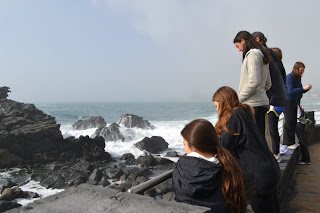
Last night, as I celebrated my birthday, I hoped to be able to visit the beach. Fortunately, a Sicilian friend was able to drive us to a part of Catania that was new to me, a new beach for me to enjoy. Although I am aware that Sicily is an island, and that I am surrounded by water, it was relieving to my mind to witness the ocean firsthand. Maybe it was because it was at night, but the tranquil nighttime beachscape was quite a change from the daytime bustle of the city’s center. The beach, deserted at this late hour, calmed my nerves.

The particular scent of the beach was what did it in. The salty perfume is much stronger on the Sicilian shore than on any beach in the United States and the water rolls softly onto the sand. A slight glow from the moon reflected off the froth that accumulated as small waves eased their way into the larger body of water.
It was almost as if the sea was an instrument playing the music of crashing waves. I have been to many beaches in my life, and I know that tourists crowd them and disrupt their natural flow.

Here in Catania, where non-European tourists are uncommon, it seems that the ocean reflects the attitude of the people, who seem more relaxed living their daily lives than the people I see back in the States. This assurance of peace and calm has helped me embrace the people, culture, and language even more.

Monday, June 13, 2011

Time in Sicily

Written by Derek Olson, Student, CET Intensive Language and Culture Studies in Catania.


In Sicily, my American anxiety for the proverbial value of time, and time lost, is put to the test. However, even if I wanted to live the same frenetic life I lead in the States, I wouldn’t have the energy here. Before coming to Italy I never considered how exhausting a full-immersion language experience would be. That must mean it’s working.

There is a wonderful atmosphere of tranquility in Sicily, Italy’s deep south. Though I enjoy this repose, acclimating to it requires a patience I never could have managed at home. As our professor Paola Servino remarked on the first day of class, “In Italy, one must always wait.” Convenience stores don’t inhabit every street corner to instantly fulfill my shopping needs. Fortunately, there is a fair trade off; every block has a panificio or pasticceria with delicious snacks and delectable sweets.


Running errands can be frustrating here but not because of the distance one must walk to a specialized shop. This city is enjoyable on foot. However, on more than one occasion I have traversed half way across the city to find a store closed. Most shops have slightly irregular hours and everything shuts down for an afternoon break called “la pausa.” In fact, the city becomes rather quiet during the hottest part of the day (see photo of Piazza Teatro Massimo, above). There are more than 20 times as many people in the city center at 2am than 2pm. Though the afternoon is quiet, the night life is more active than Mount Etna. The quiescent afternoon erupts into amicable gathering at night. (See photo of Teatro Massimo at night, below).


Sicilians, who consider themselves distinct from other Italians, have a few things they are proud of: their food, their families, but above all their people. I am amazed by the alacrity with which they make friendships. I grew up believing personal accomplishments to be the most fulfilling part of life, but for Sicilians, relationships are the true treasures. Simply put, Americans live to work, and Sicilians work to live. Experiencing these different philosophies is the greatest cultural exchange I could have.

Thursday, April 28, 2011

Winding Down, Looking Back

Written by Angela Pisoni, Student, CET Intensive Language and Culture Studies in Catania.

As the semester comes to an end, the students are thinking about their favorite CET activities and how the program could have flown by so quickly. Below are some of Angela Pisoni's favorite memories from the Traveling Seminar to Rome.

It is difficult to believe that we’re approaching the final two weeks of our Catanese semester! It seems like yesterday that we took to the skies to travel to Roma for the three-day Traveling Seminar. Leading the way were our Resident Directory Janet Lawrence and Sicilian history professor Ivana Santonocito.

After checking into our hotel on Friday morning, we wasted no time in beginning our Roman adventure. First stop, no surprise, was The Vatican followed by the Sistine Chapel. To our relief, we were able to skip the seemingly endless line to meet our amazing tour guide, who led us through The Vatican Museums, imparting knowledge along the way in a perfect mixture of Italian and English. Later we had a delicious group dinner.
Saturday was chock full of many wonderful sights – the Colosseum, Roman Forum, and Museo di Risorgimento.

After the full morning, we had the afternoon free to discover Roma for ourselves. We visited many ‘must-sees’ including the Spanish Steps and Trevi Fountain (where many a coin was tossed!).

For the final piece of our Roman escapade, we visited Villa Borghese, home of the second largest park in Roma, as well as the Galleria Borghese. Needless to say, it was the perfect bookend for our Roman traveling seminar – bellissimo! Later in the day we all parted ways to embark on our respective spring break travels. Ciao, Roma!


Looking back, I see this trip as the perfect anchor for my semester in Catania, because it provided both a bonding experience for the group and a better understanding of how Sicily fits into the broader context of Italian history.


Edited by Janet Lawrence, Resident Director.

Friday, April 8, 2011

Sicily: A Melting Pot

Written by Sam D'Anna, Student, CET Intensive Language and Culture Studies in Catania.


One day I was taking a quick break from my run just outside Piazza Falcone near the seashore. Because of its vast open space and well-preserved concrete, this piazza is a prime spot for pick-up basketball games. Though on this particular day a group of young men were playing a cricket match. As I caught my breath, I leaned up against the fence to get a better view of the action. Within seconds one of the players hit a pop fly out of the fence. The ball landed about ten feet from where I was standing. Quickly, I ran to grab the ball so that I could return it. I approached a player, but he showed no interest in meeting me. The only thing he was looking at was the ball in my hand.

Absentmindedly, instead of using my Italian, I said “Here you go!”

Immediately the man looked up at me. After realizing what I had just said, I corrected myself and said “Mi dispiace, ecco."

He continued to stare for a few more seconds, as if he still did not understand what I said. Loudly, he shouted out to his other friends in what I believe was Hindi. They came circling around me.

I introduced myself and told them where I was from in Italian. The first man understood. He told me they were from India and asked if I wanted to play. My eyes lit up. I was not expecting this to happen.

Within minutes they were throwing me their side-armed pitches that bounced in the dirt coming at me at what seemed like 100 mph. I swung away at every pitch hoping that was the right thing to do. I never could quite get the hang of swinging that awkward, flat bat, but I was able to hit a few that traveled no more than a mere 20 feet.

I probably had close to 30 strikes when I finished batting. Maybe there is no strike limit in cricket. Maybe they were just letting the rules slide a bit for me. After ten minutes I was exhausted.

The first man approached me again, this time he handed me the ball. He pointed to where he had been pitching and said “Go there!” So I went and stood at the artificial mound they had created out of old blankets and waited for him to signal that he was ready. I was nervous.

Even after all my years of playing football and baseball, I knew this probably was not going to be something I was good at. Even though I didn’t know what I was doing, I tried to imitate his actions.

After another ten minutes, he came up to me again, put his hand on my shoulder and just laughed. Probably at my horrible play.

There was not a moment that went by during the game where I didn’t learn something new.

The same goes for everyday life in Catania. It’s possible to meet someone from virtually every corner of the world in this unique city. Anyone you meet, whether they are Sicilian or an immigrant, has an interesting story and shares an equal interest in who you are.


Edited by
Janet Lawrence, Resident Director.

Wednesday, March 30, 2011

Southern Hospitality

Written by May Bayer, Student, CET Intensive Language and Culture Studies in Catania.

Southern hospitality is not only an American phenomenon. In Sicily, you may be cut in line mercilessly at the post office or pharmacy, but you will also find some of the most open and hospitable people I’ve ever met.

My first night in Catania, I stayed in a hotel before moving into our apartment. I was tired, jet-lagged, and nervous to be in a new place all by myself. Online reviews had said I would have to carry my suitcase up three flights of stairs to get to my room, but I couldn’t even open the front gate of the hotel.

The hotel manager Oscar came to my rescue. He explained that to open the gate, I had to first pull, then push (a method which everyone else seemed to already know. This information would come in handy for other gates I encountered in Catania). He also dragged my huge suitcase up the never-ending flight of stairs.

In my room, I immediately passed out from exhaustion, but when I woke up the next morning, the hospitality continued. Oscar served me a huge breakfast—a crème-filled croissant, an entire loaf of bread with jam or cheese, cappuccino, and fruit juice. When it was time for me to go, he gave me directions to find my apartment, carried my suitcase downstairs for me, and offered to give me a ride. I thanked him and declined his offer—surely he was just being polite.

But as I lugged my suitcase along the sidewalk, I got confused and wondered if I had missed the correct street. Suddenly I heard someone behind me. “May!” It was Oscar. I had gone the wrong way, and he had run after me to tell me. He insisted that I let him carry my suitcase, and he led me to my new apartment—which turned out to be right next to the hotel! I thanked him again, hardly beleiving how much he had gone out of his way for me. He told me to come visit the hotel anytime for a coffee.

Again, I assumed this was just a polite formality. But after living in Catania for two months, I now understand that Oscar was not an exception, but an accurate representation of Sicilian hospitality. I really am welcome at his hotel for coffee anytime.

Since that first day, I have witnessed all sorts of kind acts that would be unheard of at home. For class one day, another student, Sam, and I had to interview a person in the street. The person we found insisted on buying us coffee while we asked our questions. We ended up sitting at a café with him for half an hour and he promised to take us on a tour of Catania.

I soon forgot about his promise.


That Friday, though, he called and took all six CET students on a perfect tour of the city—buying us gelato from his favorite gelateria (which is now our favorite gelateria), showing us a historic castle on the sea, and a cool restaurant where you can eat underground in a grotto.

I am still surprised every time someone follows through on an offer like that. It happens all the time—when we accidentally became part of a birthday party that was happening in the Piazza, when our professors insisted on taking us out for coffee in the middle of class, when the doctor gave me a ride home after my appointment. Sicilians may seem tough at first, but they take hospitality to a whole new level, in a way that seems completely natural for them. It’s hard for me to get used to.


What does it say about our culture that I am so shocked every time I witness this kindness? Maybe the rest of the world needs to take a lesson from the Sicilians. As for me, I am going to take Oscar up on his offer of coffee at the hotel.


Edited by Janet Lawrence, Resident Director.

Tuesday, March 15, 2011

Top Alterna-Picks for Roaming in Rome...


Written by Janet Lawrence, Resident Director

Make the best of the Traveling Seminar to Rome! We'll cover the absolute must-sees like the Vatican, the Colosseum, and the Borghese Gallery as a group, but in your free time check out the Trevi Fountain, the Pantheon, the Spanish Steps, Castel Sant'Angelo, and the Capitolini.

BUT WAIT THERE'S MORE! Here's a very short list of my Roma alterna-picks:

All museum-ed out?
Climb the hill to Giannicolo park for an excellent panorama of the city below. The lively neighborhood of Trastevere lies at the foot of the hill. Reward yourself with a pasta dinner. Sample the Roman specialties Bucatini Amatriciana or my absolute favorite, Cacio e Pepe.

Love English literature?
Try out the city's metro system and visit the Protestant Cemetery, where Keats and Shelley are buried. I believe I once got some students to recite poetry there...I promise I'll spare you all that.

Wanna get outta the city?
The fabulous (really) sites, Villa D'Este and Villa Adriano, are just a bus ride away!

Tuesday, March 8, 2011

The Mount Etna Miracles


Written by Janet Lawrence, Resident Director

Mount Etna may be best known for its eruptions, hot lava, and destruction, but it also has a niche in the miracle department.

This Saturday, CET Catania united with CET Siena and CET Florence for a tour of Catania's mistress from above, Mount Etna. It was a rainy, misty day and our guide Sandro worried the fog would obscure the view of the summit.

During our tour, the group traced the oldest vestiges of Etna's volcanic rock on the shores of Aci Castello to its newest output at the volcano's summit.

The 500,000-year-old volcanic rock on the shore has been smoothed and rounded by the
Mediterrenean water so that it interlocks
like cobble-stones. Quite different from the brand new, flinty charcoal-like substance that we would find on the volcano's summit. It erupted from the volcano just a few weeks ago.

As we made our way up the mountain, we learned about Etna miracles. The veil of Sant'Agata was said to have shielded sacred objects from oncoming lava at various moments in history. Then, during the 1991-93 eruption, the town of Zafferano was nearly overtaken by hot magma.

Our students visited the site where the lava flow miraculously stopped--just a few short kilometers from the city center. Of course, Etna's inhabitants haven't always been so lucky--we also saw the rooftops of homes that were swallowed up during eruptions.


Then our very own miracle--the thick fog parted as we made the final ascent to the Silvester Craters, near the summit of Etna. A corridor of blue sky emerged through which we had an unobstructed view from the craters to the Mediterrenean shoreline far below.

Sandro, a man who has made a career of studying this feisty volcano, said he had never seen the view look so particularly beautiful.